
How to run a dive centre: the complete guide
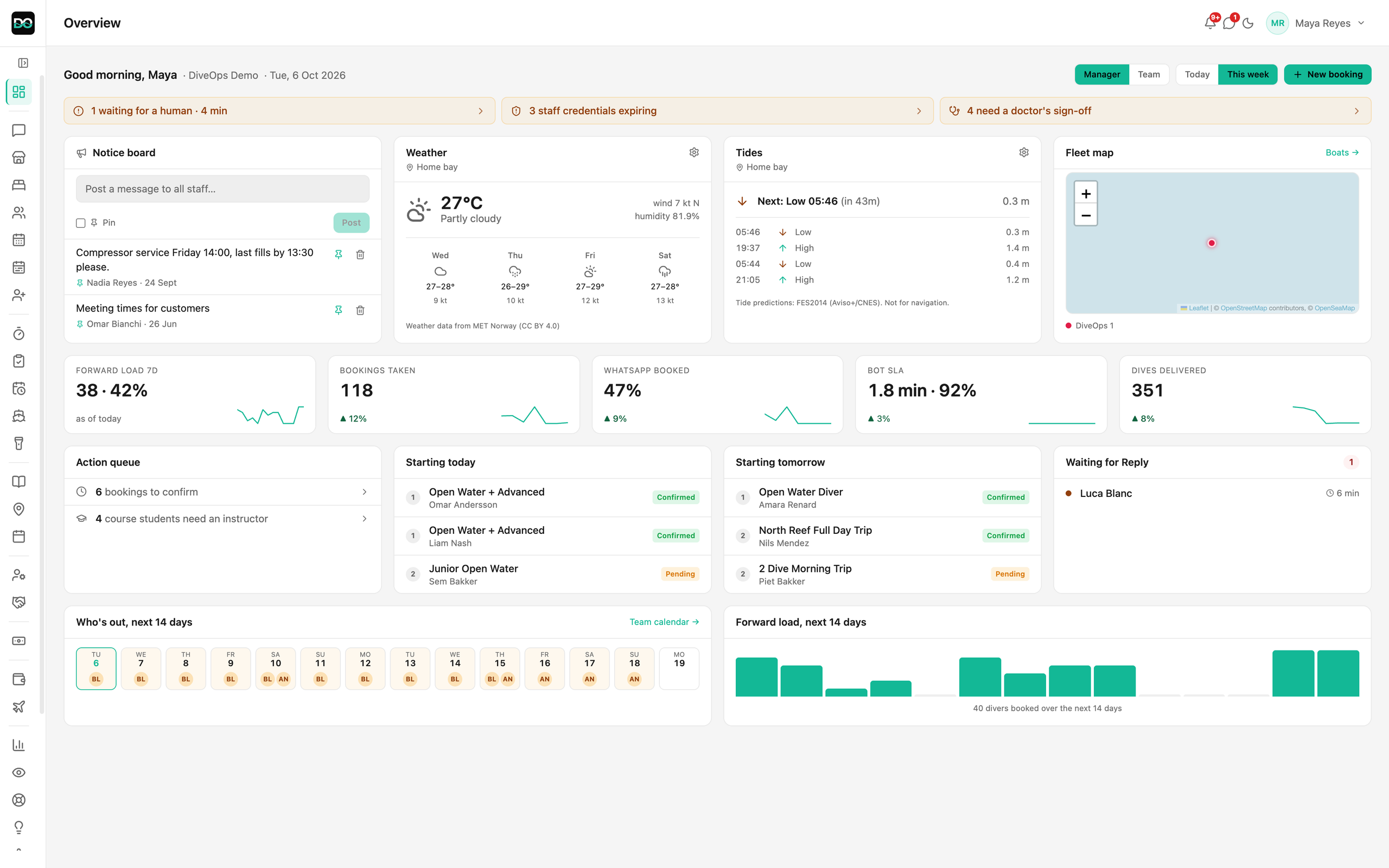
Running a dive centre means keeping six jobs moving at once: answering enquiries, planning the dive day, managing boats and gear, handling the team, tracking the money, and running your website. This guide walks through each at a high level and links to the deeper playbooks for the parts that quietly eat your week.
 (opens full size in a new tab)
The short version
- A dive centre runs on six jobs: front desk, the dive day, boats and gear, money, team and customers, and website and insight.
- Most enquiries now arrive on WhatsApp, often at night and in another language, so answering fast is where bookings are won or lost.
- The trip sheet is the day's real test: who is on which boat, with which guide, inside safe capacity.
- The hours disappear in the handovers between tools, so a centre that keeps these jobs in one system rewrites far less.
- Start with your biggest leak, usually enquiries or the trip sheet, then work outward.
Where do dive centre enquiries come from, and how do you answer them?
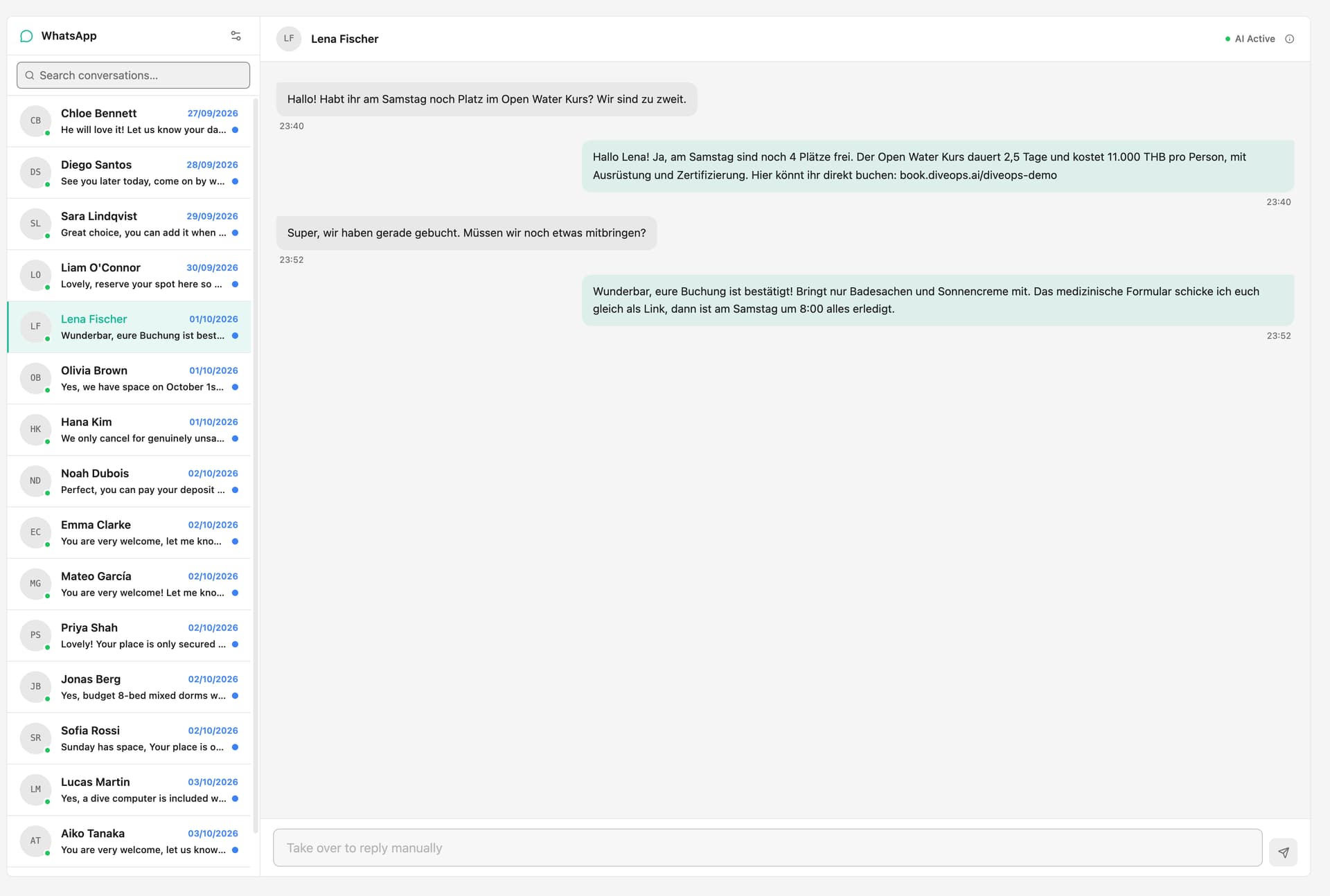
For most centres the first contact is now a message rather than a phone call or an email, and a large share of that lands on WhatsApp, often outside opening hours and rarely in English. The centre that replies first, clearly and in the diver's own language, usually wins the booking, because a diver planning a trip is messaging three or four centres and comparing the replies.
The practical answer is not longer hours but a smaller gap between the question and a useful reply. Quick-reply templates, honest coverage of evenings and days off, and a way to answer in the languages your divers actually message in all help. Where a human cannot be free around the clock, a 24/7 WhatsApp AI for dive centres answers the routine enquiries the moment they arrive and sends the booking link, so a slow reply never costs you the trip.
Every booking, whether it came from WhatsApp, your website, a walk-in or the phone, should land in one list with its source, payment and medical declaration attached. If a reply just becomes a ticket for staff to chase the next morning, that is where the season leaks. For the detail, see how to answer WhatsApp enquiries faster.
How do you plan the dive day?
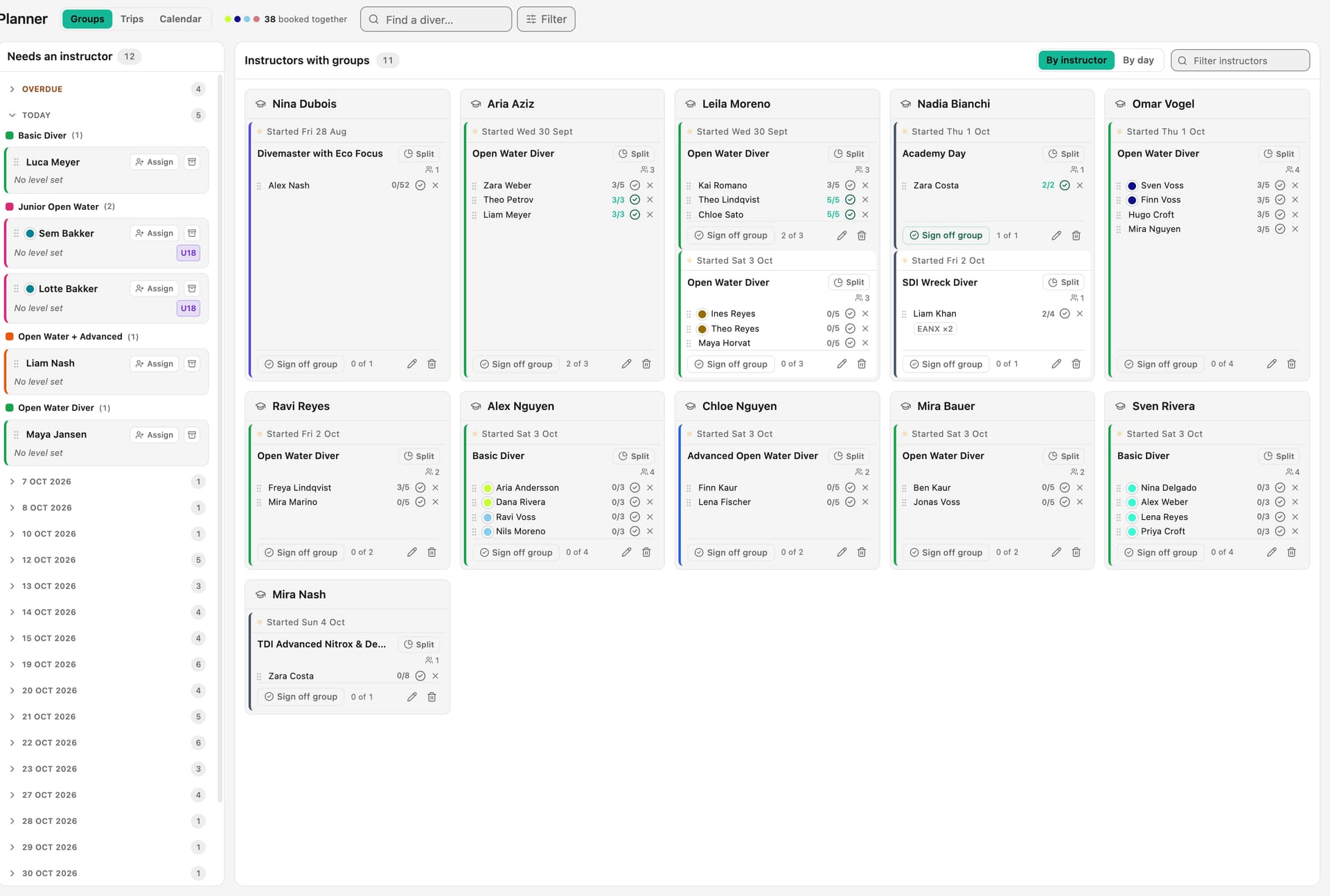
The dive day is planned in three layers that must agree: the season schedule decides which sites run on which days, the bookings decide who is coming, and the trip sheet is where those two meet the boat. Get the trip sheet right and the morning runs itself. Get it wrong and you are rewriting the whiteboard on the dock at 7am.
A good day builds itself from data you already hold rather than from a blank grid. The boats appear from the year schedule, dive groups are built once then dragged onto a boat as a unit so every student moves with their leader, and each boat shows a live count against its capacity as you place people, so over-loading is caught before it happens. Anyone booked but not yet placed sits in a clearly labelled list so the orphaned diver cannot hide.
For the full breakdown of what belongs on the sheet and the failure modes that cause rewrites, read the dive centre trip sheet guide. To see the schedule, groups, sites and drag-and-drop sheet working together, see the dive day tools.
How do you manage boats and gear?
Boats and gear are where compliance quietly turns into risk. Every boat certificate, gear service interval and safety check carries a due date, and the job is to be warned before it lapses, not after you have missed it. A live GPS map showing where each vessel is, with recent trails, turns planning around the fleet from memory into fact.
The kit room needs the same discipline: an inventory with tap-based check-outs that record who took what, condition tracking, and a clear alert the day something goes overdue. Many centres also run regulator and equipment servicing as a paid job, from check-in to collection, with the customer told when it is booked in and again when it is ready.
Fuel is the detail owners forget to price. Logging each fill lets consumption be worked out boat by boat and pulled straight into the books. See how the live map, kit room, servicing desk and compliance alerts fit together in boats and gear.
How do you keep the money straight?
The money side of a dive centre is really three jobs: taking payment at the desk, keeping proper books, and paying the team. A front-desk till for gear and retail, with tax worked out and a salesperson recorded on every sale, closes the gap between what was sold and what was banked. Counting the drawer at close and cross-checking it against every till sale and booking payment tells you at once if you are over or short.
Underneath the till, every sale, booking payment and expense should flow into real double-entry books with a profit and loss statement your accountant can actually use, rather than another spreadsheet rebuilt each month. Payroll then runs with course and retail commissions built in, and a course split across two instructors divides itself.
Taking card payments through your own Stripe account keeps the money landing with you, and card fees can be up to 20% lower than the terminal rates centres typically pay. See the till, books and payroll in the money tools.
How do you run the team and keep customers current?
A dive centre lives or dies on its people, and the admin around them is easy to let slide until an instructor's insurance or a medical lapses mid-season. A staff directory that holds certs, languages, insurance and medicals per person, and warns you before anything expires, turns that from a scramble into a routine. Roles then decide exactly who sees the money, the inbox or the schedule.
Give staff their own portal with payslip PDFs and year-to-date totals and you stop fielding pay questions by message. Leave requests approved in one tap keep the team calendar honest, and emailing every instructor their groups for the day takes one click.
Customers are the other half of this job. Enquiries should become profiles with certification level, status, source and last contact, kept current on their own as messages come in, so the same detail is never re-keyed. See the team and customer tools.
How do you bring it all together?
The hours in a dive centre rarely disappear inside any one job. They disappear in the handovers between them: the enquiry re-typed into the booking, the booking re-typed onto the trip sheet, the trip sheet totalled again into the books. A centre that keeps these six jobs in one system, reading from one plan, rewrites far less and spends more of the day on the water.
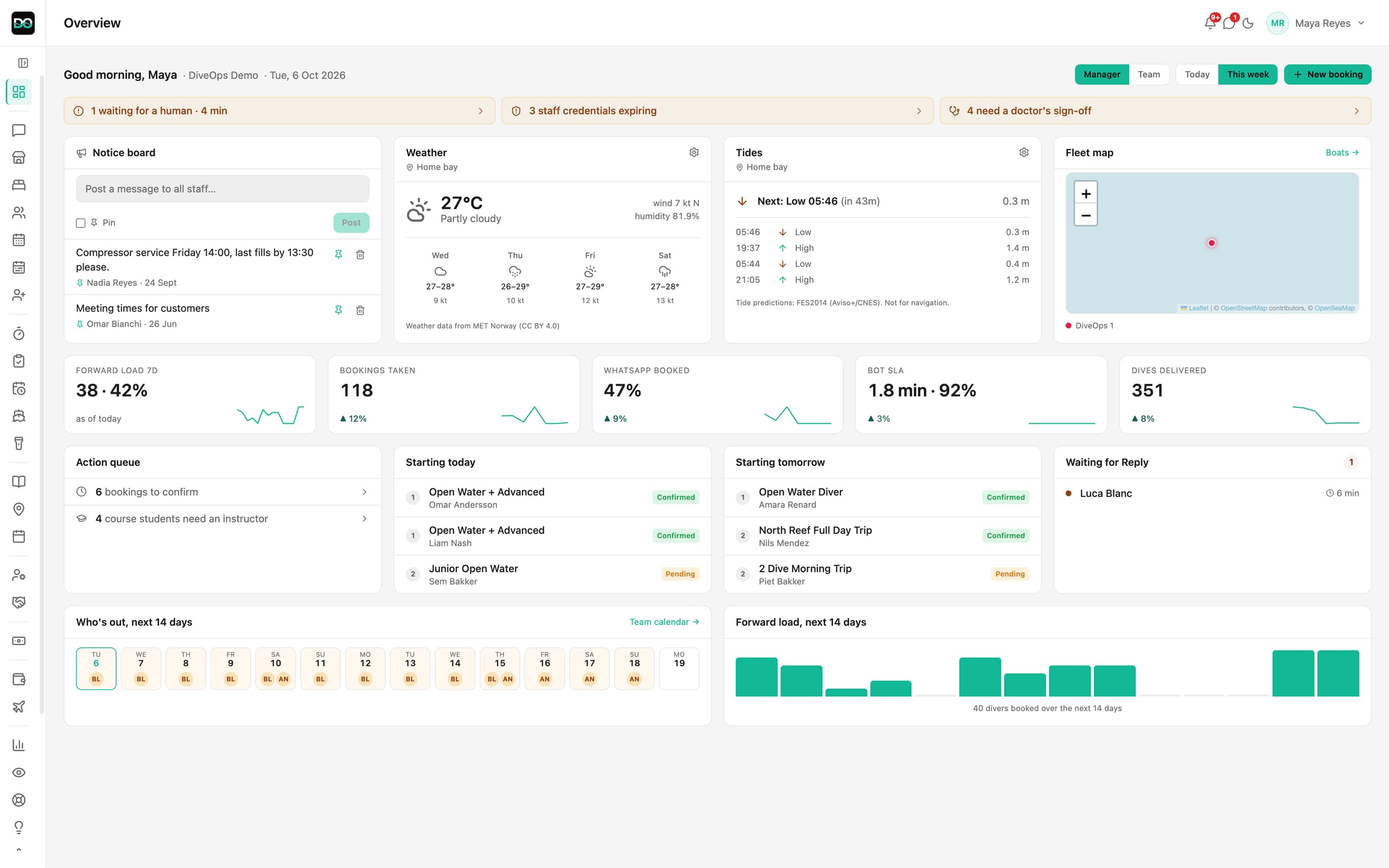
That is the case for treating a dive centre as one operation rather than a stack of separate tools. If you are weighing up how to do that, read the dive centre management software guide and see the whole picture on the product overview. DiveOps was built by a former Koh Tao dive professional, validated with 20 Koh Tao dive centres before launch, and now runs operations for one of the world's largest SSI dive centres.
Questions, answered.
What are the main jobs involved in running a dive centre?
Six recurring jobs: the front desk (enquiries and bookings), the dive day (schedule, groups and trip sheet), boats and gear, money (till, books and payroll), team and customers, and your website and insight. Most day-to-day admin sits in the handovers between these jobs rather than inside any single one.
What is the hardest part of running a dive centre day to day?
For most owners it is two things at once: answering enquiries fast enough to win the booking, and building a trip sheet that survives late bookings, no-shows and weather. Both involve constant last-minute change, so the centres that cope best plan from live data rather than a whiteboard.
Do you need dive-specific software to run a dive centre?
Not strictly, but generic booking tools ignore boats, gas, courses, instructor ratios and the trip sheet, so staff patch the gaps with spreadsheets. Purpose-built software assembles the operational day for you and keeps enquiries, bookings, operations and finance in one place instead of several disconnected screens.
How does a dive centre reduce admin without hiring more staff?
By closing the handovers where time leaks and automating the routine. Answering repeat enquiries automatically, seeding the trip sheet from the schedule, and letting the books fill from real payments removes re-keying. See the cut-admin guide for where the hours actually go and how to claw them back.
Sources
See it run your dive centre.
A short live walkthrough on your real schedule. No slides, no sales patter.