
How should a dive centre run gear rentals and servicing?
Rental kit is one of the quietest sources of income in a dive centre, and one of the quickest ways to lose money. Regulators drift past their service date, a BCD goes home with a diver, a wetsuit comes back torn and nobody knows who had it. This guide covers what to track for each item, how to stop kit going missing, how to price rentals and deposits, how often kit needs servicing, how to run customer servicing at a profit, and how DiveOps handles it.
The short answer
Give every item of kit a code, a size, a condition and a service date, and log who has it. Rent it at a set rate with a deposit, check its condition when it comes back, and service it on the manufacturer's interval. Run customer servicing as a paid job with its own margin.
 (opens full size in a new tab)
The short version
- Every item needs a code, a size, a condition, a service date and a record of who has it.
- Count availability per item and size, so you never rent out more than you own.
- Take a deposit linked to replacement value, and settle it when the kit comes back.
- Service on the manufacturer's interval and keep the record with the item.
- In DiveOps the kit room, rentals and servicing desk share one record, with warnings before anything is due.
What should a dive centre track for each item of kit?
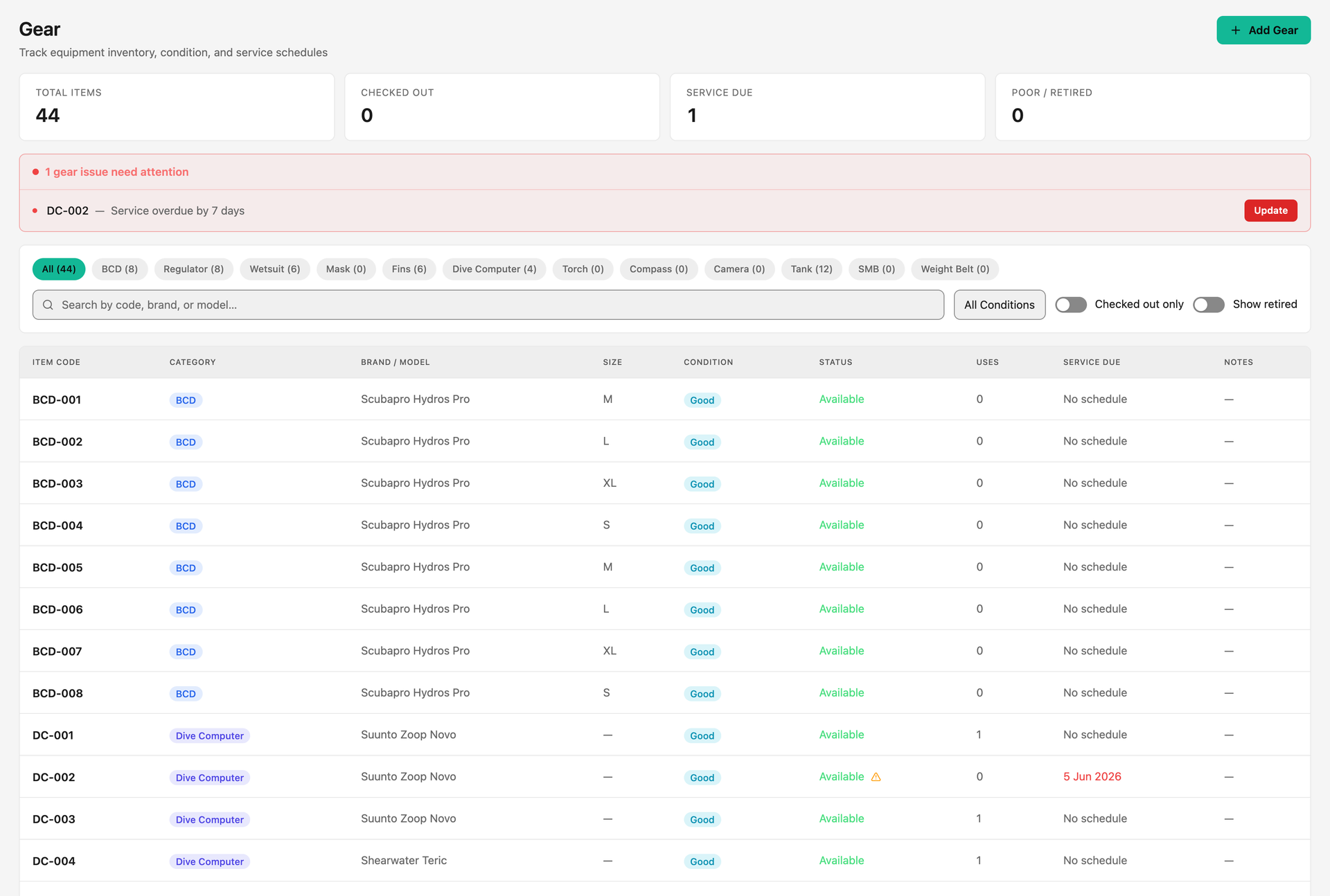
Track enough to answer three questions about any item at any time: where is it, is it safe to use, and when is it next due for a service. That means a record per item, not per category.
- An item code, marked on the kit, and its category, brand, model and size
- Its condition, from new to retired, updated when it comes back
- Its service interval and next service date
- Who has it now, and since when
- How often it has been used, and its purchase date and cost
How do you stop rental kit going missing?
Log every check-out and return against a named person, and look at what is still out every day. Most missing kit is not stolen: it is in a staff car, on the wrong boat or still with a diver who left early. A due-back date and a daily list of overdue items find it while it is still easy to recover.
Count availability per item and size. A wetsuit in S, M and L is three stock lines, not one, and the person renting it out should see how many are free for the dates asked before saying yes. A deposit, and terms the diver agrees to before taking the kit, make the conversation about a missing item far easier.
How should you price rentals and deposits?
Price rentals by the way divers use them: per dive for computers and torches on a single trip, per day or per week for a full kit on a course or holiday. Set the deposit with the item's replacement value in mind, so a lost computer does not become a loss for the centre.
Agree in advance what happens when kit comes back damaged or late: how much of the deposit you keep, and whether you can charge more when the damage costs more than the deposit. Remember that a deposit you hold is not income. It only becomes income if you keep it.
How often does dive gear need servicing?
Follow the manufacturer's service interval for each item, which for regulators is commonly yearly or after a set number of dives, whichever comes first. Rental regulators work much harder than a private diver's, so many centres also inspect them more often between full services.
Cylinders need periodic visual inspection and pressure testing at intervals set by local rules, and they fall under pressure equipment regulations in many countries. BCDs need inflator and dump-valve checks, and dive computers need batteries and seals looked after. Whatever the item, keep the record with it: the date, what was done and by whom. That record is what an insurer or inspector will ask to see.
What should you check when kit comes back?
Check its condition before it goes back into the pool, and record what you find. Rinse it, look for tears, leaks and missing parts, and rate it so you can see an item wearing out before it fails on a dive. Anything damaged should be taken out of use until it is repaired, with a note saying why, so nobody picks it up on a busy morning.
How do you run customer servicing at a profit?
Treat each service as a job with a price, a cost and a status. Check the item in with the customer's details and the agreed price, note the promised date, and track it through to collection. If you send kit to an outside technician, record what they charge and any parts used, so you know the real margin on each job rather than just the fee.
Tell the customer when it is ready, and remind them before their next service is due. A reminder at the right time brings the same regulator back next year, which is the easiest repeat business a shop can win.
How does DiveOps handle gear, rentals and servicing?
DiveOps tracks every item of kit with its category, item code, size, condition and service interval. Staff check kit out and back in on a tap-based screen, recording condition on return and any damage notes. Warnings appear when a service is overdue or due within 30 days, when an item is in poor condition, or when it has been out for more than 24 hours.
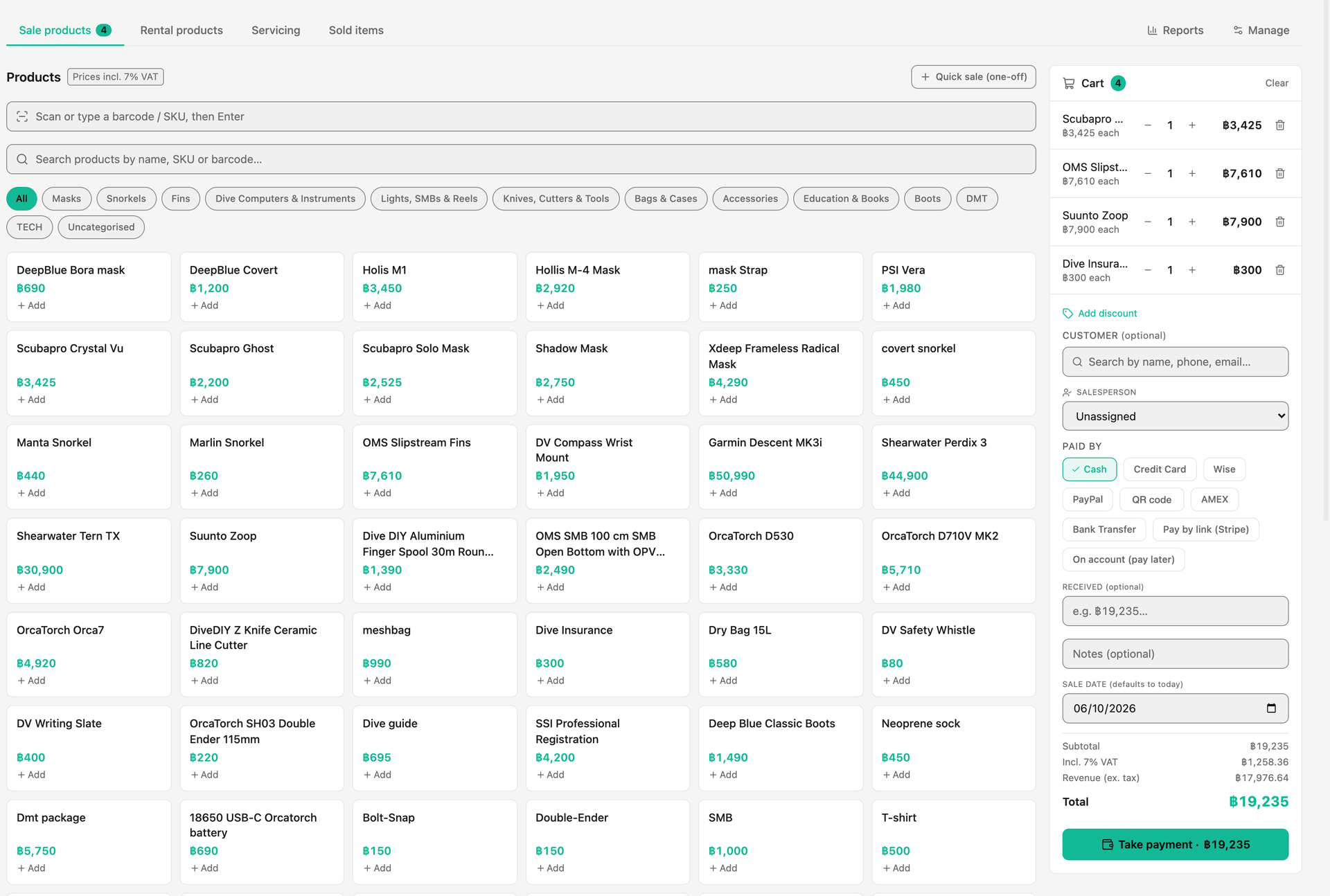
Rentals run from the shop. Each item has a rate per day, per dive or per week, a suggested deposit and a replacement value, and shows how many are free for the dates you pick, so you cannot rent out more than you own. The diver agrees to your rental terms, the fee and deposit are taken together, and on return you record each item's condition, give back the deposit or keep part of it, and add a damage or late charge if needed. Rental kit can also go on a diver's booking and be paid with everything else.
Customer servicing runs from the same shop as a paid job, from checked in through with provider and ready to collect, with the provider's cost and parts recorded so each job shows its margin. Customers are emailed at check-in, when the job is ready, and around six weeks before their next service is due. The WhatsApp assistant quotes your rental prices from the same list.
Questions, answered.
Should rental deposits count as income?
No. A held deposit is money you will give back. It only becomes income if you keep some or all of it for damage or loss.
How do I know what rental kit is free on a given day?
Count availability per item and size. In DiveOps each rental item shows how many are free for the dates you choose, and you cannot rent out more than you own.
Can DiveOps remind customers to service their own regulators?
Yes. Set a service interval on the job and DiveOps emails the customer a reminder around six weeks before their next service is due.
Can staff take kit out without it being a rental?
Yes. Gear check-out logs who took what and when, separately from customer rentals, so the kit room always knows what is out.
Sources

See it run your dive centre.
A short live walkthrough on your real schedule. No slides, no sales patter.